

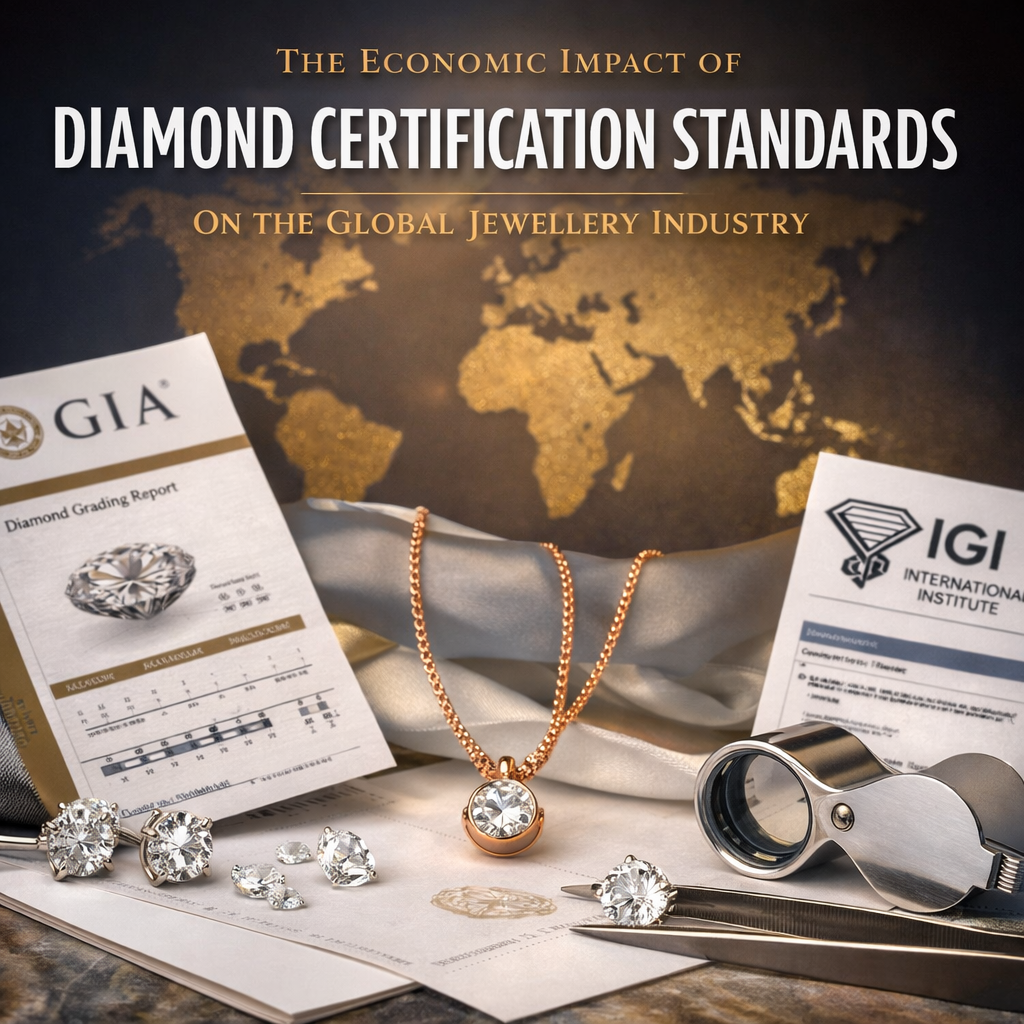
In the global jewellery industry, certification is far more than a technical document — it is an economic driver. From mining regions to high-end retail websites, diamond certification standards influence pricing, consumer trust, trade relationships, and long-term brand value.
For modern retailers — especially those operating an online lightweight diamond jewellery store — certification shapes not only compliance but conversion. And for buyers investing in diamond jewellery for women, it represents assurance that beauty is backed by authenticity.
Let’s explore how certification standards impact the global jewellery ecosystem.
Understanding Diamond Certification Standards
Diamond certification exists at multiple levels within the industry:
1. Conflict-Free Trade Certification
International certification systems were created to prevent conflict diamonds from entering the global market. These frameworks regulate rough diamond exports and imports, helping stabilize international trade and increase transparency.
Economically, this allows producing countries to participate in global commerce while giving downstream retailers confidence in supply integrity.
2. Independent Laboratory Grading
Gemological laboratories evaluate diamonds using standardized grading systems based on:
- Cut
- Color
- Clarity
- Carat
A grading report directly affects valuation. Two diamonds of similar size can differ significantly in price depending on lab assessment.
For an online lightweight diamond jewellery store, displaying grading information reduces uncertainty — a critical factor when customers cannot physically inspect the piece.
3. Responsible Supply Chain Standards
Industry councils and responsible sourcing initiatives establish guidelines for ethical business practices, traceability, and compliance.
Brands that align with these standards often gain:
- Improved brand credibility
- Stronger retailer partnerships
- Access to international markets
- Reduced legal and reputational risk
Economic Impact Across the Supply Chain
Diamond certification affects every stage of the value chain.
Mining & Rough Diamond Trade
Certification frameworks enable smoother cross-border trade by standardizing export documentation. This reduces barriers in international transactions and strengthens legitimate market participation.
However, compliance costs can impact smaller producers, particularly artisanal miners who may struggle with administrative requirements. As a result, certification can lead to industry consolidation, where larger, organized operators gain market advantage.
Cutting & Polishing Hubs
Countries like India, a global leader in diamond polishing, have adapted to certification-driven demand by upgrading compliance systems and record-keeping.
This has resulted in:
- Greater export competitiveness
- Higher quality control standards
- Improved global credibility
Yet, it also increases operational expenses — influencing wholesale pricing structures worldwide.
Retail & E-Commerce
Certification’s economic influence is most visible at the retail level.
In physical stores, customers rely on sales consultants. Online, they rely on documentation. This makes certification particularly critical for digital-first brands.
For sellers of diamond jewellery for women, certification:
- Justifies premium pricing
- Reduces return rates
- Builds long-term customer loyalty
- Enhances brand authority
For brands such as Gemlay Jewels, integrating certification into product storytelling strengthens competitive positioning in crowded digital marketplaces.
Pricing Power & Market Transparency
Certification reduces information asymmetry — a core economic concept where one party holds more information than the other.
Without certification:
- Buyers assume higher risk
- Sellers struggle to justify pricing
- Market inefficiencies increase
With certification:
- Consumers are more confident
- Sellers gain pricing clarity
- Resale value improves
- Market competition becomes quality-driven
This transparency benefits structured markets but increases pressure on uncertified segments.
The Rise of Lab-Grown Diamonds & Market Segmentation
One of the most significant shifts in recent years is the rise of lab-grown diamonds.
Their growth has:
- Increased affordability
- Expanded access to diamond jewellery
- Created new pricing tiers
- Pressured natural diamond margins
Certification bodies now clearly differentiate between natural and lab-grown diamonds. This distinction influences pricing, marketing, and consumer perception.
For an online lightweight diamond jewellery store, offering both options — clearly labeled and certified — allows broader audience targeting without sacrificing transparency.
Lightweight collections, in particular, benefit from lab-grown alternatives because they make daily-wear luxury more accessible.
Certification Costs & Business Strategy
While certification adds value, it also adds cost.
Retailers must account for:
- Lab grading fees
- Compliance documentation
- Supply chain audits
- Administrative processes
For smaller, lightweight pieces, certification cost as a percentage of product value can be significant. Businesses must strategically decide which pieces require full certification and which can rely on supplier-backed grading.
Balancing cost and perceived value becomes a key profitability factor.
Digital Consumer Behavior & Trust Signals
Today’s online jewellery shopper is research-driven. She compares specifications, reads reviews, and evaluates return policies before purchasing.
Certification functions as a powerful trust signal.
When browsing diamond jewellery for women, buyers look for:
- Grading reports
- Metal purity details
- Authenticity assurance
- Transparent pricing
For brands like Gemlay Jewels, presenting certification clearly — not hidden in technical sections — enhances confidence and strengthens brand loyalty.
Certification as Competitive Advantage
In a saturated e-commerce environment, differentiation matters.
Certification supports:
- Higher search visibility
- Stronger product credibility
- Reduced customer hesitation
- Improved long-term brand equity
By positioning itself as a transparent, trustworthy online lightweight diamond jewellery store, a retailer can move beyond price competition and build authority.
Global Trade & Regulatory Implications
Certification also affects:
- Import/export documentation
- Market access in regulated economies
- Compliance with evolving ethical standards
Retailers operating internationally must stay aligned with regulatory frameworks to avoid trade disruption and reputational damage.
As traceability technology evolves — including digital tracking and blockchain applications — certification will likely become even more integrated into global supply chains.
The Future of Diamond Certification
Looking ahead, the industry is moving toward:
- Greater transparency
- Stronger ethical sourcing expectations
- Increased consumer education
- Clear differentiation between natural and lab-grown stones
Certification will continue shaping pricing models, market segmentation, and consumer confidence.
Retailers who treat certification as part of their brand identity — not merely documentation — will be best positioned for sustainable growth.
Conclusion
Diamond certification standards have fundamentally transformed the global jewellery industry.
They influence:
- Trade flows
- Pricing structures
- Consumer behavior
- Brand trust
- Market segmentation
For businesses like Gemlay Jewels and any modern online lightweight diamond jewellery store, certification represents both responsibility and opportunity.
And for consumers purchasing diamond jewellery for women, it provides what matters most — confidence that elegance is supported by authenticity.
In an increasingly digital marketplace, that confidence drives the entire economy of fine jewellery.